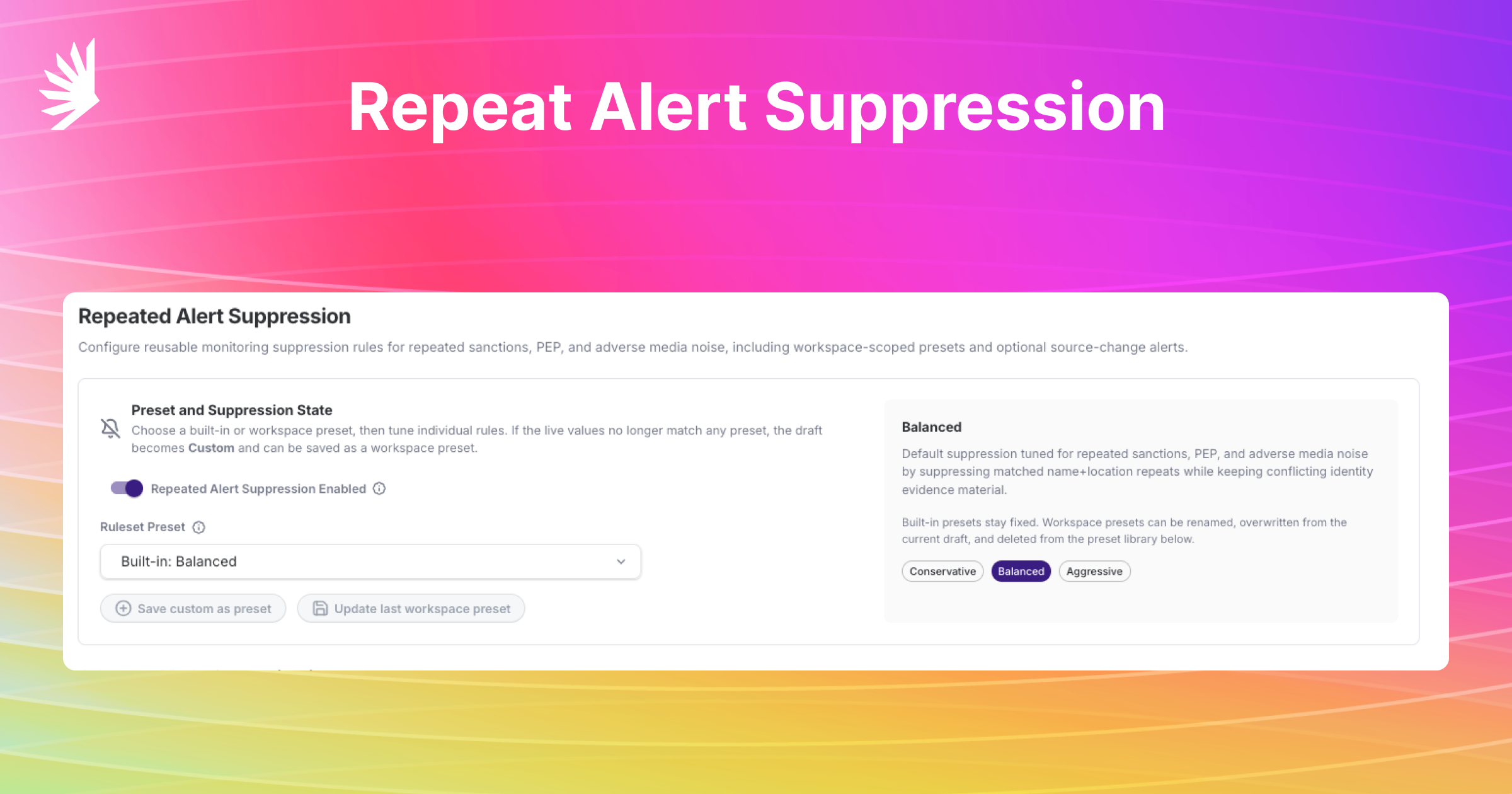
The same customer alerts again and again. In ongoing monitoring, the match an analyst cleared last week comes back this week: same name, same list, same articles. The analyst opens it, reads the same hit, reaches the same conclusion, and writes it down again. Multiply that across every profile re-screened monthly, and repeats crowd the queue.
Minerva now compares every repeat to what came before, and gives your team the option to suppress the ones with nothing new.
Repeated Alert Suppression checks each new monitoring result against the profile's prior screening results: the identity details behind the match (name, date of birth, locations), the article itself, and the sources it came from. A genuinely new story, or identity details that no longer line up, lands as a fresh alert. The rest is treated as repeat noise and stays out of your queue. Analyst review stays exactly where it was.
It's a better answer than the ways teams have had to cope.
Until now there's been nothing in between reviewing every repeat and not screening the customer at all. So analysts start clearing repeats without reading them, or a customer goes on a list that skips screening entirely. Both create the exact risk the monitoring exists to catch, and leave nothing to show an examiner.
You decide how much gets suppressed
Three built-in presets set the baseline:
- Conservative suppresses only the clearest repeats.
- Balanced suppresses recurring noise while keeping materially different results visible.
- Aggressive suppresses the most, still requiring corroborating identity evidence first.
From there, every rule is yours to tune: how far back to compare, how close a name has to be, how much identity evidence must line up, and whether repeats should re-alert when new sanctions or politically exposed person (PEP) sources appear.
Different business lines can save their own presets per workspace, and you can turn suppression off entirely.
Every change is on the record
When tuning and configuring repeated alert suppression, Minerva keeps the full audit record, with a history to record the business reasons. The lineage of past changes stays reviewable, and earlier configurations can be restored, with the rollback itself kept in the audit trail.
When an examiner asks why a repeat never reached an analyst, the answer is written down: the ruleset that made the call, who set it, and when.
Part of how Minerva handles false positives
Repeated Alert Suppression takes the repeats. AI Entity Matching screens every subject so fewer false matches reach the queue in the first place, and Agentic Disposition clears most of the false positives that do land, with the reasoning recorded.
Combined, up to ~99% of the false positives are resolved compared to traditional screening solutions.
Get started
Curious what it would suppress on your own monitoring? Book a walkthrough or email support@gominerva.com.

Download this Resource
Stay a step ahead with insights and updates from Minerva
Explore more


All-In-One, AI-Enhanced Risk Screening
We put the world's data to work on a comprehensive compliance platform.
Discover more efficient, effective investigations.