At a glance
- Who to check: Canadian and foreign public officeholders, heads of international organizations and certain family members and close associates.
- How to identify them: compare customer information with screening results and public sources; investigate missing or conflicting details.
- What happens next: assess risk, complete the required checks and follow applicable account-access and sanctions rules.
- What to keep: supporting evidence, the decision and any required approvals and records.
In this article
Politically exposed person (PEP) screening checks whether a customer holds, or has held, a public position covered by Canadian anti-money laundering rules.
The account steps below apply to banks and other financial entities, securities dealers and casinos. Other sectors and life insurance businesses have different requirements. This guide is an overview; follow current FINTRAC account guidance and legislation for the full requirements.
1. What is a politically exposed person?
A politically exposed person (PEP) holds, or held, one of the public offices listed in Canadian law. Examples include a member of Parliament or a mayor. A public-sector job alone doesn't make someone a PEP.
The Financial Transactions and Reports Analysis Centre of Canada (FINTRAC), Canada's financial intelligence unit, provides guidance on these checks. They are preventive measures to help stop financial services being used to launder the proceeds of bribery and corruption. PEP status does not imply wrongdoing.1
2. Types of PEPs and how long status lasts
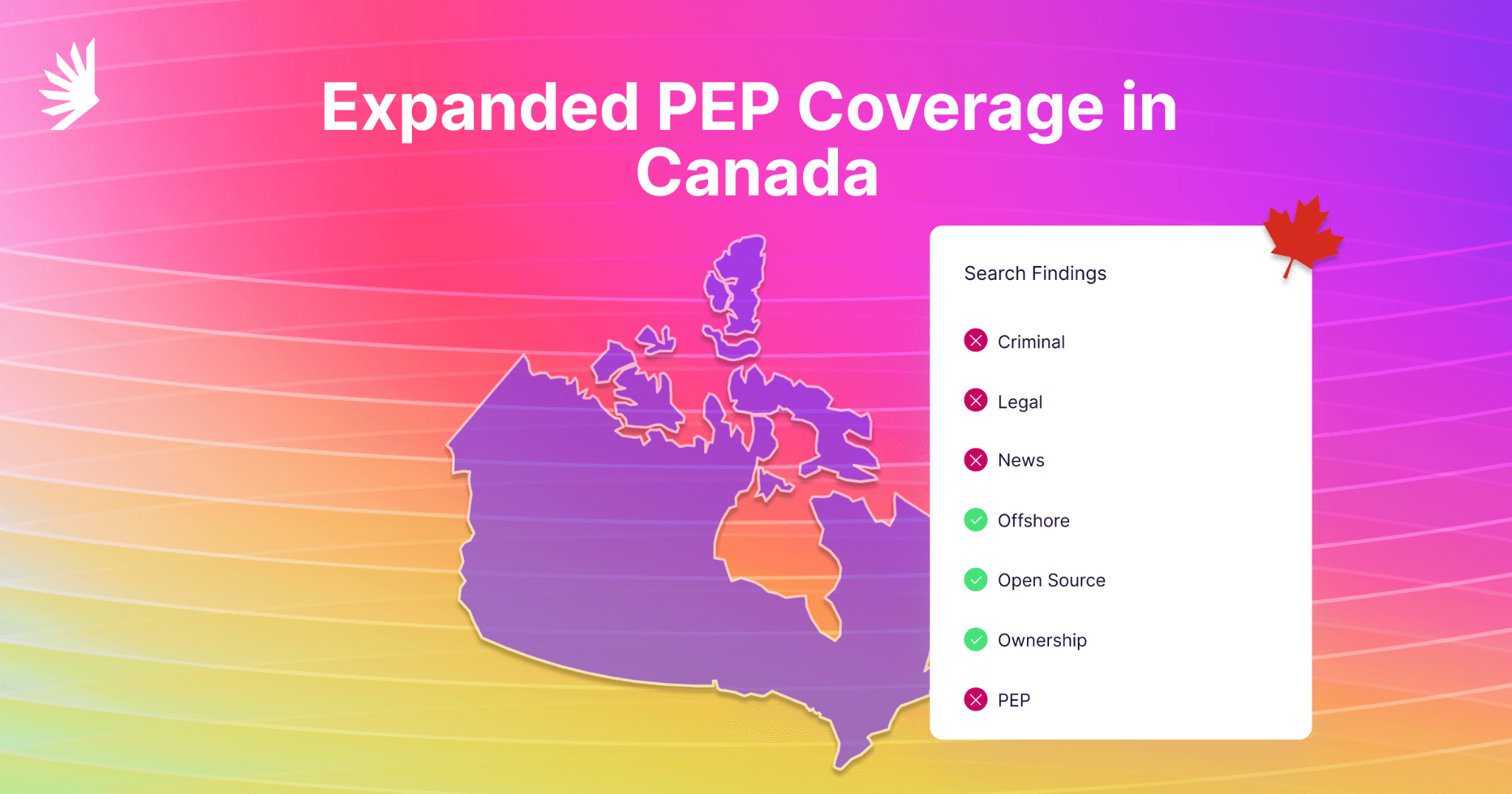
Canada has specific definitions for domestic PEPs, foreign PEPs and heads of international organizations (HIOs). Your screening must cover Canadian offices and heads of international sports bodies, as well as foreign politicians.
| Type | Who is included | Examples | Time period |
|---|---|---|---|
| Domestic PEP | People in specified Canadian public offices | • Provincial legislator • Mayor • First Nations chief serving as chief officer of a local government • Judge of a provincial appeal court, the Federal Court of Appeal or the Supreme Court of Canada |
Holds office now or held it in the last five years |
| Foreign PEP | People in specified offices of a foreign state, regardless of nationality | • Foreign head of state • Cabinet minister • Ambassador |
Ever held the office; status continues after death |
| Head of an international organization (HIO) | The main leader of one of: • An organization created by national governments • One of its institutions • An international sports organization |
United Nations Secretary-General; head of the World Health Organization within the UN system | Holds the leadership position now or held it in the last five years |
The domestic definition covers specified judges and chief officers, not every judge, Indigenous leader or band councillor. For domestic PEPs and HIOs, leaving office through death also starts the five-year period.1
Family members covered by the rules include:
- A spouse or common-law partner.
- Biological or adopted children.
- Parents.
- The parents of a spouse or common-law partner.
- Siblings.
Former partners can remain covered; FINTRAC's guidance explains the time limits. Close associates can include business partners or people in an intimate relationship, rather than every acquaintance.1
3. How to identify a PEP
Take reasonable steps to identify PEPs, HIOs and specified family members:
- When opening an account. You can ask the customer directly about public office and relevant relationships. Also check for close association with a foreign PEP.
- During periodic reviews. Repeat these checks, including for close associates of foreign PEPs. People are elected, appointed or leave office, so a customer's PEP status can change.
- When new facts suggest a PEP connection. Investigate information giving reasonable grounds to suspect the connection, including close association with a domestic PEP or HIO.
A customer may have a relevant connection without holding office themselves. For example, if their spouse is a cabinet minister, establish the spouse's position and the relationship. FINTRAC does not prescribe a blanket “first-degree” search of every customer's family.2
Financial entities also have duties for authorized users of prepaid payment product accounts. Certain transactions trigger separate checks and deadlines.
At account opening or after detecting a relevant fact: take reasonable steps to determine PEP, HIO or relevant family/associate status within 30 days after that event. Where required, checks into where deposits and wealth come from, and senior management approval, share that deadline. See your responsibilities below. Periodic reviews and transactions have separate rules.2
FINTRAC also permits using information already on file, public sources or commercial screening data. It does not require a manual web search of every customer.3
Understand what your provider's database covers
Database screening is only as effective as its coverage. Understand which roles, jurisdictions and levels of government your provider includes, and which roles it excludes.
Check coverage beyond prominent national figures, such as heads of state, senior politicians and ambassadors. Provincial, municipal and other local officials may be covered differently, and some roles depend on a seniority threshold.
Judges show why these distinctions matter. FINTRAC's definitions cover judges of provincial appellate courts, the Federal Court of Appeal and the Supreme Court of Canada, as well as foreign supreme, constitutional or other courts of last resort. Confirm that your provider's methodology follows these definitions and use additional checks where material coverage gaps exist.1
Minerva's Canadian PEP database is built through research using official sources, with location and age information to help distinguish people who share a name.4
If customer information points to public office but screening returns no match:
- Check which sources were searched and whether name or date filters excluded the person.
- Check an official directory and ask the customer about the position.
- Record the findings and ask the provider to research any missing record.
Confirm that the result is your customer
For an existing customer, FINTRAC says a name match alone does not necessarily give reasonable grounds to suspect PEP status. Compare other information, such as address, birth date or age.1 Use the available details to assess the match and record what remains uncertain.
4. What to do after identifying a PEP
Record the public position, country and dates in office, then apply the category's risk treatment.2
| Person identified | Risk treatment | Next action |
|---|---|---|
| Foreign PEP, or their: • Defined family members • Close associates |
Treat as high risk | Complete the additional checks below |
| Domestic PEP or HIO, or their: • Defined family members • Close associates |
Assess the relationship's money-laundering or terrorist-financing risk | If high risk, complete the additional checks; otherwise continue monitoring based on risk |
Use your risk policy to assess the account's purpose, expected activity, countries involved and reliable information about income, wealth or alleged misconduct. Record why those facts support your assessment.5
5. Can you do business with a PEP?
PEP status alone does not prevent a customer relationship. Apply the required checks for the person's category and assessed risk. Where additional account checks apply, senior management must approve keeping the account open.
Your decision must also follow your documented risk policy and applicable account-access requirements, sanctions and other legal rules.
What does serving a PEP require?
Apply the checks for the person's category and risk.

6. Your responsibilities: funds, approval and monitoring
For foreign PEPs and their defined family members or close associates, and for domestic PEPs, HIOs and their defined family members or close associates assessed as high risk, you must:2
- Investigate the source of funds or virtual currency. Take reasonable steps to establish where deposits or expected deposits come from, such as employment income or a property sale.
- Investigate the source of wealth. Take reasonable steps to establish how the person accumulated their wealth, such as business ownership or inheritance.
- Obtain senior management approval to keep the account open. At account opening or after detecting a relevant fact, obtain approval and take the reasonable measures to establish deposit and wealth sources within 30 days of that event.
- Apply enhanced safeguards. Take additional steps to verify identity, keep customer information current and monitor activity at a frequency suited to the risk.
7. Keep records and supporting evidence
When you obtain the required senior management approval, keep a PEP account record containing:
- The PEP's or HIO's public position and organization.
- The date you identified the customer as a PEP, HIO, family member or close associate.
- The sources of funds or virtual currency and wealth, if known.
- The approving manager's name and approval date.
Retain this record for at least five years after the account closes.2 Other records have their own requirements: keep ongoing-monitoring records for at least five years after creation.
Support your conclusions with retrievable evidence. Attach or link retained material under your privacy and retention procedures. These are suggested examples, not a FINTRAC template or actual bank records.
| Finding to explain | Supporting material to retain or reference |
|---|---|
| Identity match or exclusion | • Identity-verification record reference • Dated screening result • Notes comparing customer details with the result |
| Public position and dates | Saved official profile or page capture, with its source URL and access date |
| Risk assessment and follow-up | Completed assessment with reasons, relevant customer answers and supporting documents; monitoring plan |
| Funds, wealth and approval, where required | Customer explanation and documents used to check it, such as payroll records or a sale agreement; dated approval record |
Record missing information and attempts to obtain it. A bare conclusion such as “low risk” does not explain what you checked or why you reached it.
8. Test your screening provider
Ask who researches missing records, whether reviewers can see original sources and dates, and how estimates are distinguished from verified facts.
Compare providers using the same customer information and screening scope. Record any deliberate configuration differences. Include:
- Known Canadian PEPs checked against official sources, including mayors, chiefs and specified judges.
- Known non-matches, including people who share a PEP's name.
- Incomplete records and name variations relevant to your customers.
Missing a PEP can leave required checks undone. Excessive false positives also undermine screening: irrelevant alerts consume review time and can delay review of genuine PEP matches. Compare known PEPs missed, the share of alerts that are false positives, and review time per alert. In a hypothetical test with 1,000 alerts and 999 non-matches, 99.9% of alerts are false positives for the team to review. Look for fewer false positives while still finding genuine matches.
Minerva's matching controls let teams adjust how names, dates and other information affect results, then test changes in a Calibration workspace before applying them to live screening.6
Complete the review
The completed file should explain the identity decision, public position, risk assessment and required follow-up, with supporting evidence another reviewer can retrieve.
Sources
- FINTRAC: definitions and identification; Act, section 9.3; Finance Canada: domestic PEP definition, including First Nations chiefs.
- FINTRAC: account duties and records; Regulations: timing, section 121, record contents, section 123, retention, section 148.
- FINTRAC: PEP questions, question 7.
- Minerva: Canadian PEP research methodology.
- FINTRAC: risk assessment guidance.
- Minerva: Match Scoring Guide.