Product
October Product Updates: UK PEP Data, Adverse Media & MCP
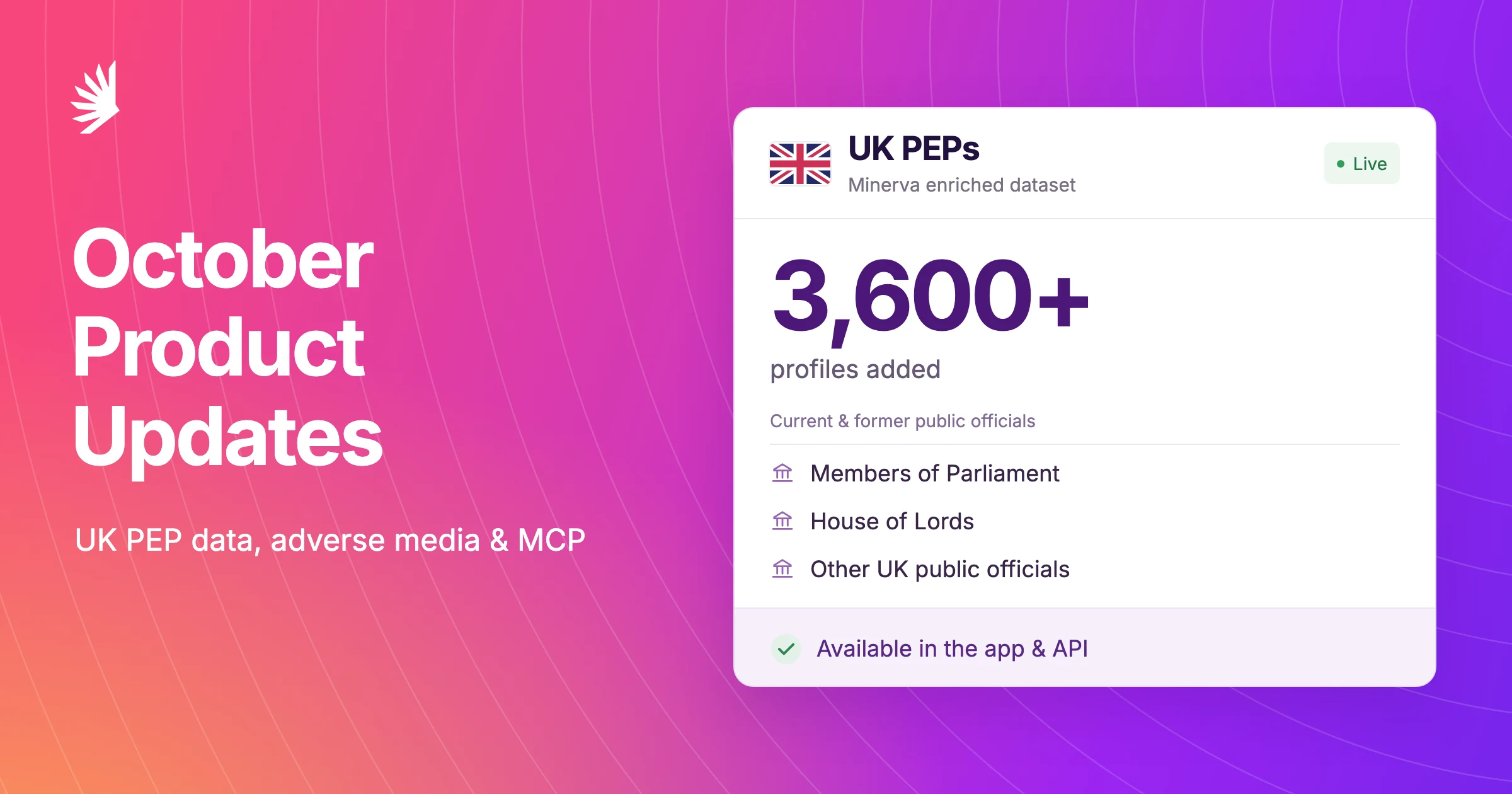
3,600+ UK PEP profiles added in the app and API, more precise Risk Inference, expanded Adverse Media search and Minerva MCP.
Your screening tool can miss relevant reporting because a name is spelled differently, yet flag unrelated articles because they contain an exact name match. Many teams turn adverse-media screening off as a result.
We set out to fix that by building our own adverse-media dataset. We've processed more than 2 billion news records and continue to classify 2 to 3 million incoming articles each day. Minerva's screening uses the people, locations and risk described in that reporting to find relevant stories and return fewer irrelevant matches.
Some popular screening tools rely on third-party providers that look for an exact name match. They don’t support fuzzy matching: finding a name even when the spelling or punctuation differs. A missing hyphen or a one-letter variation can be enough for the engine to miss an article about your customer.
Even when a name matches, these tools often return articles without tags for location or type of risk. That leaves analysts to work out which stories are about their customer and which are about someone else with the same name. Some customers estimate that up to 99% of the adverse-media alerts from their previous screening tools were false positives.
We extract names and locations from licensed news articles, classify the risk in each article and store that information in Minerva's own dataset. We built a search index around those details so you can match variations of a name and filter the results by location and type of risk.
If your customer is John Smith in Toronto, you can narrow a fraud search to stories that connect his name to that city.
Even with low-cost classifiers, a single pass through billions of articles can cost hundreds of thousands of dollars. Reprocessing the archive as classifications change can push the total past $1 million.
We built models specifically for this workload so we can keep classifying the daily feed and revisit older reporting as our classifications improve.
Your team can find relevant reporting that was previously missed, with articles already classified and ready to screen. That reduces the processing done while a customer waits to open an account and keeps new reporting available for ongoing monitoring.
Minerva uses location and risk to filter out stories about the wrong person before they reach your analysts. For the matches that remain, Agentic Disposition gathers the source evidence and recommends whether to clear the alert or investigate further. With Minerva’s data and Agentic Disposition, the same team can handle twice as many screening alerts.
Adverse media is just the starting point. We're tackling many of AML's screening problems at their source: poor data quality and incomplete classifications that create noise, hide relevant risk and drive unnecessary review.
We plan to enrich these datasets with more useful classifications, from the roles people play in events to the relationships between people and organizations. Minerva’s API already assesses whether a news report implicates the person being screened or mentions them in another role. Bringing that context into the dataset will give teams more of the information they need to assess risk.
We also plan to apply this approach to other datasets, turning fragmented information into a clearer picture of who businesses are dealing with and how those relationships connect. The goal is to help teams uncover risk earlier and make better decisions about customers and partners, well beyond compliance screening and without reviewing every record by hand.
The dataset already powers adverse media screening and ongoing monitoring in Minerva. Large marketplaces and consumer businesses can also buy the data separately. Their teams can search and filter the classified records in their own systems while Minerva keeps the underlying data up to date.
For a Minerva walkthrough or to discuss data access, book a conversation or email support@gominerva.com.

Product
3,600+ UK PEP profiles added in the app and API, more precise Risk Inference, expanded Adverse Media search and Minerva MCP.

Insights
Which Canadian sanctions lists should you check? Learn how to investigate matches, record evidence, report concerns and screen again.

Product
September product updates introduce Case Management, expanded adverse media coverage, enhanced analytics, richer exports and profile custom fields.
We put the world's data to work on a comprehensive compliance platform.
Discover more efficient, effective investigations.