At a glance
- What it is: a rating of each customer's risk of involving your business in money laundering, terrorist financing or sanctions evasion. It isn't a credit score.
- Who needs one: businesses covered by Canada's AML law must have one. They include banks, credit unions, payment companies, securities dealers, mortgage brokers and lenders, and, since April 2025, financing and leasing companies that finance or lease passenger vehicles, or property other than real estate that is used in a business or worth C$100,000 or more.
- How it's decided: by your own written policy. You weigh who the customer is, which products and services they use, where their money moves and whether their activity matches the purpose they gave you. Some customers are always high risk: foreign politically exposed persons (senior foreign officials) and their family members and close associates, businesses whose owners you can't confirm, and customers with property owned or controlled by or for someone on Canada's sanctions or terrorist lists. In that last case you also stop any transaction involving the property, tell the RCMP or CSIS without delay and report it to FINTRAC immediately.
- What it changes: how closely and how often you check the customer. For high-risk customers the law requires extra checks, called special measures.
In this article
Disclaimer: This guide is a practical overview, not legal advice. Check FINTRAC's current risk assessment guidance and the law, and get qualified legal advice.
1. What is a customer risk rating?
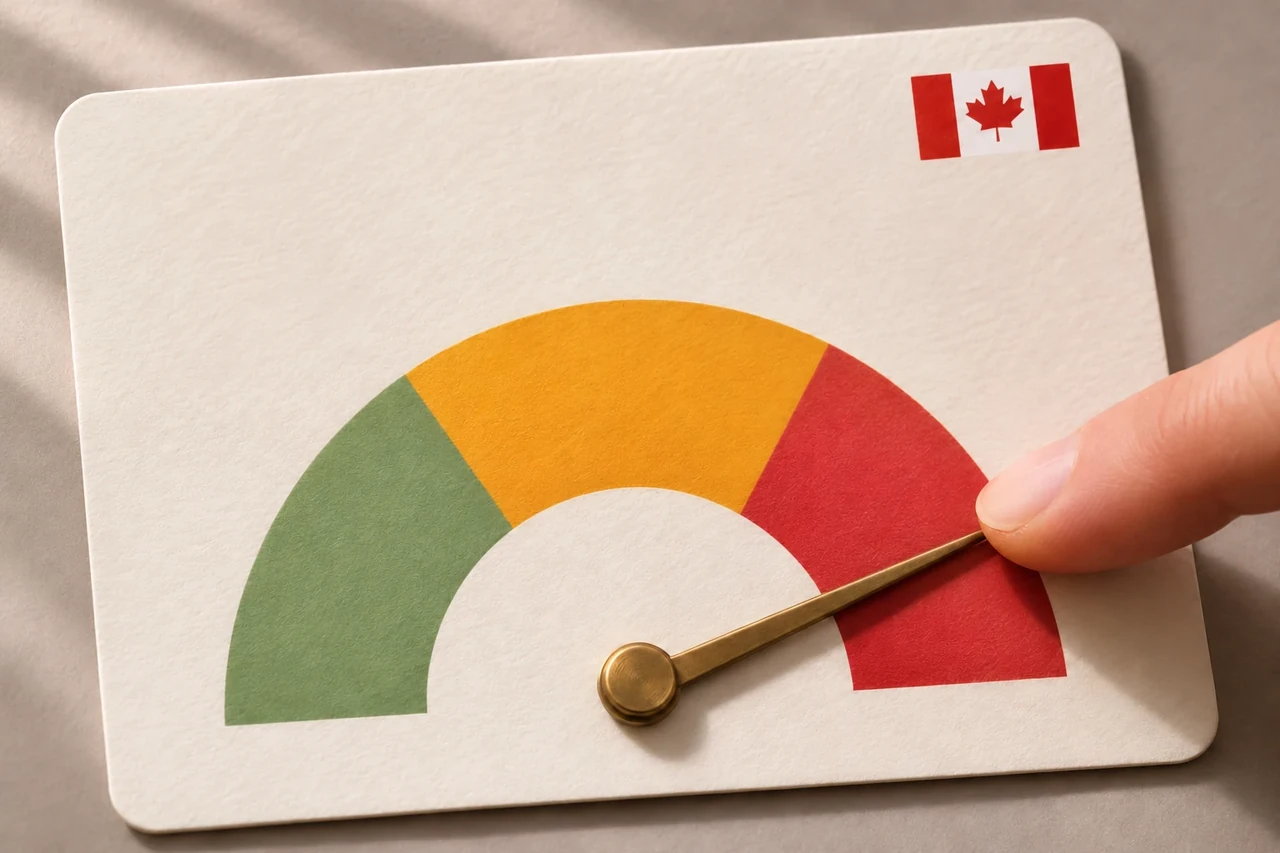
A customer risk rating is the level of financial-crime risk you assign to a customer, usually low, medium or high. You use it to decide how much checking that customer gets when you take them on and for as long as you deal with them.
Financial crime here means money laundering, terrorist financing and sanctions evasion, which is getting around the legal restrictions on dealing with certain people, groups and countries. This isn't credit risk. A borrower who has never missed a payment can still be high risk for money laundering, and one with poor credit can be low risk.
The rules come from Canada's Proceeds of Crime (Money Laundering) and Terrorist Financing Act. The Financial Transactions and Reports Analysis Centre of Canada (FINTRAC) is the federal agency that supervises it. FINTRAC publishes guidance on these ratings, examines businesses and can fine those that don't comply.1
This guide says "customer" and FINTRAC says "client", so you'll also see this called a client risk rating. It's part of your AML compliance program, and FINTRAC's examiners check it when they review your know-your-client (KYC) records.
How you rate is up to you, except for three kinds of customer who are always high risk. The law requires you to assess and document the risk your customers pose and to apply special measures to the ones you rate high.1
2. Who has to rate customers in Canada?
Every business the law covers must rate its customers. FINTRAC calls these businesses reporting entities. They include:2
- Financial entities: banks, credit unions, caisses populaires, and trust and loan companies.
- Money services businesses: including payment companies, currency exchanges, crypto dealers and crowdfunding platforms.
- Mortgage administrators, brokers and lenders, since October 11, 2024.
- Financing and leasing companies, factoring companies and check-cashing businesses, since April 1, 2025. Financing and leasing companies are covered when they finance or lease passenger vehicles, or property other than real estate that is used in a business or worth C$100,000 or more.
- Others, some only for certain activities: securities dealers, life insurers, casinos, real estate brokers and accountants. FINTRAC's list has every sector.
If your business loans don't finance vehicles, equipment or other property: FINTRAC's list may not name you. Check its sector pages before deciding the law doesn't apply.
What penalties has FINTRAC issued over customer risk ratings?
Three recent penalties included failures in how customers were rated and reviewed:
- Pathwise Credit Union, Ontario, C$41,250 in 2026: reviews fell behind its own schedule. How often it reviewed customers didn't match their risk, and staff didn't follow its written schedule. Medium-risk reviews were overdue, and low-risk accounts were reviewed only when something prompted it. It also didn't keep customers at high risk for the period its own policy set after it filed a suspicious transaction report about them.
- Canaccord Genuity, securities dealer, C$544,500 in 2025: high-risk files weren't kept up to date. FINTRAC checked 14 high-risk customer files and found ownership and customer details not updated at all, or less often than the firm's high-risk schedule required. Its reviews also discounted warning signs, such as negative news about high-risk clients, and it failed to report three suspicious cases.
- UNI Financial Cooperation, New Brunswick credit union, C$676,500 in 2026: alerts went unreviewed and it had no manual way to adjust ratings. Transaction-monitoring alerts were left unreviewed, which FINTRAC said threatened the accuracy of its risk ratings. Its risk assessment didn't show how many customers it had at each risk level, and it had no manual way to raise a rating for things its system didn't flag, such as negative news or a court order for a customer's records.
3. What do low, medium and high risk mean?
The law requires a written policy, and your policy sets the levels. FINTRAC gives no formula and no fixed number of levels; low, medium and high is only the example its guidance uses.3
The table below is one example of what a policy could say. Yours might be stricter or looser, depending on your business. Whatever you choose, write down why it fits your customers and products. FINTRAC expects that reasoning on file, and its examiners review it.3
| Level | When a customer gets this level | What you do | Review every |
|---|---|---|---|
| Low |
|
| Year |
| Medium |
|
| 6 months |
| High |
|
| 3 months |
Not every warning sign carries equal weight. A trait most of your customers share doesn't have to move a customer up a level if your policy explains why. Examples include online sign-up at an online-only lender or transfers abroad at a money transfer business. FINTRAC says to weigh warning signs together.3
4. What goes into a customer risk rating?
Risk factors fall into four areas in FINTRAC's guidance. Most make it harder to know who you're really dealing with or where their money comes from. The examples below are common ones, not a complete list. Every business and industry has its own, and your written policy should name yours.3
| Risk area | What can raise the risk |
|---|---|
| The customer: it's hard to tell who they are, who's behind them or why their money moves |
|
| Products and sign-up: what they use, or how they reach you, makes money or identity harder to trace |
|
| Countries: they or their money are tied to other countries |
|
| New products: something new you offer makes transactions harder to trace |
|
Some facts point to lower risk: low volumes and balances, small transactions, and household or registered savings accounts such as an RRSP.
Screening results are part of the rating. Screening means checking a customer's name against government sanctions lists and lists of politically exposed persons (PEPs), people who hold or once held certain senior public positions. A possible match raises an alert for someone to review. A confirmed match can make the customer high risk automatically.
An alert can also be a same-name match: someone on a list shares your customer's name but is a different person. You check this by comparing details such as date of birth. A same-name match you rule out doesn't change the rating.
News linking a customer to crime is a warning sign, but on its own it doesn't make them high risk automatically.
5. When is a customer automatically high risk?
FINTRAC's guidance names three cases in which you must treat a customer as high risk, whatever the rest of your assessment says. Outside them, one warning sign, such as a cash-heavy business, doesn't necessarily make a customer high risk.4
Separately, directives from Canada's Minister of Finance require you to treat every transaction coming from or going to Russia, Iran or North Korea as high risk, whatever the amount, and apply the special measures. Their other steps include identity checks and a record of each transaction.4
| What you've found | What to do next |
|---|---|
| The customer is a foreign politically exposed person (PEP), or a family member or close associate of one. |
|
| The customer has or controls property, such as money in an account with you, that is owned or controlled by or for a listed person or entity. |
|
| The customer is a company or other organization and you can't find out or confirm who owns and controls it. |
|
A foreign PEP is someone who holds or has ever held one of the senior positions Canadian law lists for a foreign state. Heads of state, legislators, ambassadors and presidents of state-owned companies are on that list. A listed person or entity is an individual, company or group named under Canada's sanctions or anti-terrorism laws, any other terrorist group, or a foreign state that a sanctions order covers.
Two similar situations are left to your own assessment: a Canadian PEP or head of an international organization, and a business whose complicated ownership can still be confirmed.
Every high-risk customer gets the law's special measures:
- verify their identity more thoroughly
- keep their information up to date more often
- monitor their activity more closely
- take any other steps that reduce the risk
You can keep high-risk customers unless sanctions law says otherwise. Some accounts held by PEPs, heads of international organizations or their family members or close associates need a senior manager's approval to stay open.
6. How do you assign a customer risk rating?
To rate a customer, gather the facts, check whether they're always high risk, otherwise compare their facts with your policy, then write down why and set the next review.
Gather the facts
Identity
Ownership and control
Account purpose
Screening results
Recent activity
Identity, ownership and control, account purpose, screening results, recent activity
Always high risk?
Foreign politically exposed person (PEP), or their family member or close associate
Business whose owners you can't confirm
Property owned or controlled by or for someone on a sanctions or terrorist list
Also: stop any transaction involving the property, tell the RCMP or CSIS without delay and report it to FINTRAC immediately
Record why
Facts and policy rule
Next review date
Facts and policy rule, next review date
Review again
on schedule or when something changes
Back to the start
Example 1: a credit union customer whose activity changes
Maya opens an account at Northside, a made-up credit union that uses the example policy. She's a nurse paid about C$5,500 a month and says she'll use the account for her pay and bills. Northside verifies her identity, screens her name and rates her low.
Eight months later, two transfers from abroad add up to C$48,000. That doesn't fit the account's stated use, so the analyst asks Maya about it. The rating depends on what she provides:
- If she has records that explain it: the sale agreement for her late mother's apartment and the notary's transfer record match both transfers. The rating stays low, because the records show who sent the money and why. It's a one-off; regular transfers from abroad would make her medium.
- If she can't explain it: she says it's family helping out, but she has no documents and can't say who sent the money. The rating becomes high, because she can't explain transfers that don't fit the account's purpose.
If the rating is high, the analyst's note covers the rating, reason, special measures and next step:
Rated high on March 3 under Northside's policy: activity the customer can't explain. Two transfers from abroad totaling C$48,000 don't match the stated use (pay and bills). Customer says family support; no records or sender details. Special measures: identity re-verified; records requested by March 10; account checked weekly. Compliance officer signed off. Re-rate when the records arrive; if none arrive, it stays high and the compliance officer decides next steps.
The analyst also considers whether to send FINTRAC a suspicious transaction report. A business files one when it has reasonable grounds to suspect a transaction or attempted transaction is linked to money laundering, terrorist financing or sanctions evasion. The analyst doesn't have to wait for Maya's documents to decide, and shouldn't tell her a report is being considered.5
Example 2: a leasing customer whose owners can't be confirmed
Ridgeline, a made-up equipment leasing company using the same example policy, agrees to lease a C$220,000 excavator to a paving company. Signing the lease starts a business relationship under FINTRAC's rules, so Ridgeline verifies the company, finds out who owns and controls it, and rates it.5 The corporate registry shows one shareholder: a holding company registered outside Canada.
| What the paving company provides | Rating | Why |
|---|---|---|
| The holding company's share register and its owners' IDs: two Canadian founders with 50% each. Screening clears both. | Medium |
|
| Nothing beyond the registry entry. The paving company's manager says the owners prefer privacy. | High |
|
7. When should you review a customer risk rating?
FINTRAC sets no review schedule. It expects your written policy to say how often you review customers at each level as part of ongoing monitoring.6 The example policy reviews high-risk customers every three months, medium every six months and low every year. Set intervals that fit each level's risk and that your team can keep; examiners check both.
Re-rate between scheduled reviews when something changes:
- activity that doesn't fit the purpose the customer gave you
- a new owner or controller of a business customer
- a screening alert you can't rule out, or news linking the customer to crime
- a suspicious transaction report you've filed about them (FINTRAC says to rate those customers higher)
Ratings can go down too. When a customer is no longer high risk under your assessment, the special measures can stop, and the customer moves to the new level's review schedule. If your policy keeps customers high risk for a set time after a suspicious transaction report, follow it.6
Separately, your whole compliance program needs a review every two years. Your compliance program is the set of AML policies, training and checks the law requires, run by a compliance officer you appoint. It includes the risk assessment behind your policy. The two-year review is for the program, not a review date for each customer.
8. What do FINTRAC examiners check in your risk ratings?
FINTRAC's assessment manual and guidance say examiners reviewing your customer files may:7
- test your low and medium ratings against your own criteria for high risk
- check that you monitor high-risk customers more often and apply special measures to each one
- confirm that every foreign PEP, and every family member or close associate of one, is rated high
- check that you follow up when activity doesn't match what you expected
- read the written reasons behind your ratings, including any case where you rated a customer lower despite a warning sign FINTRAC's guidance treats as high risk
If software scores your customers, write down how staff can change a score and record why. That lets a rating reflect what the system misses, such as negative news.
9. Customer risk rating checklist
Before closing a rating review, check that:
- The customer's facts are on file: identity, ownership, stated purpose, screening results and recent activity.
- You've checked whether they're always high risk: a foreign PEP, property owned or controlled by or for a listed person or entity, or owners you can't confirm. Also check for transactions with Russia, Iran or North Korea.
- The risk level matches your written policy, and any departure from it is explained.
- The rating is backed by facts: the written reason cites the facts and the policy rule behind the level.
- The next steps and review date are set: special measures if high risk, someone assigned to each open question, and the date of the next review.
10. How can Minerva help with customer risk rating?
Minerva's AML compliance software includes a configurable Client Risk Rating. You can set up the rating and your screening to follow your written policy:
- Adjust the factors your team adds, such as a suspicious transaction report you've filed or a cash-intensive business.
- Group customers by risk, product or region, and set how often each group is rescreened against sanctions, PEP and news sources.
- Build your own risk scorecard, with the factors, weights and score range for each level (in beta).
The rating scores a customer's risk from 0 to 100 and sorts it into low, medium or high. It draws on screening results, such as sanctions and PEP list matches, news coverage and registry records, plus information your team adds.8
Your analysts stay in charge of the decision. They can override the rating, and Minerva requires a reason so it's on record. Use the score as one input to the rating your written policy sets: map its levels to your policy and record why the defaults fit or what you changed. Your business stays responsible for the rating however it's calculated.3
Book a demo to see the Client Risk Rating, analyst overrides and rescreening schedules in Minerva.
Sources
- Proceeds of Crime (Money Laundering) and Terrorist Financing Act, section 9.6; Regulations, section 156 and section 157. FINTRAC: compliance program requirements, risk assessment guidance, compliance assessment manual
- FINTRAC: who must report, financial entities, money services businesses, mortgage sector, financing or leasing entities, regulatory changes in force April 1, 2025. FINTRAC's list labels financing and leasing companies, factoring companies and check-cashing businesses "New as of July 10, 2025"; their obligations came into force April 1, 2025. Regulations, section 1(2) (passenger vehicle definition)
- FINTRAC risk assessment guidance: relationship-based risk assessment (including delivery channel risks), scoring, worksheet, Annex 1 expectations (including responsibility when a service provider performs the assessment) and Annex 5
- FINTRAC: risk assessment guidance, Annex 5, Table 12, politically exposed persons, listed person or entity property reports, beneficial ownership, ministerial directives. Regulations, section 157
- FINTRAC: suspicious transaction reports, business relationships, beneficial ownership. Suspicious transaction reporting regulations, section 9
- FINTRAC: ongoing monitoring, risk assessment guidance, Annex 5, Table 13, credit union penalty notice, C$41,250, compliance program requirements, two-year review
- FINTRAC: compliance assessment manual, sections 3.1.3 and 3.2.2; risk assessment guidance, Annex 1 expectations
- Minerva: Client Risk Rating, profile groups, screening frequencies, risk assessment scorecards (beta), screening settings you can tune and test